
Types of Barrel Pumps and How to Pick the Right One
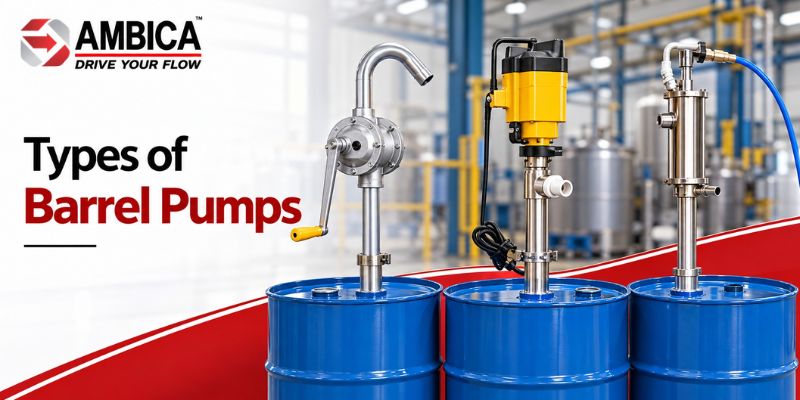
Table of Content:
Quick Takeaways
- Barrel pumps transfer liquids from drums without lifting or tilting heavy containers.
- The three main types are hand-operated, motor-operated, and pneumatic barrel pumps.
- Hand-operated pumps suit small volumes, while motor-operated pumps are ideal for frequent liquid transfer.
- Pneumatic pumps use compressed air and suit compatible flammable liquids. In hazardous areas, check the zone rating and earth the equipment.
- Choose the pump material based on the liquid’s chemical properties to prevent corrosion and leaks.
- Consider flow rate, liquid viscosity, drum size, power supply, and safety requirements before selecting a barrel pump.
- For thick or abrasive liquids, an AODD pump may be a better option.
Barrel pumps, also called drum pumps, are used in many workplaces to move machine oil, acids, diesel, and paint thinners from drums into other containers. However, not every pump is suitable for every liquid or workplace. Some pumps are operated by hand, while others use an electric motor or compressed air. Choosing the wrong pump can damage its parts, cause leaks, or create safety risks when handling flammable liquids.
To choose the right barrel pump, you need to consider the type of liquid, how much liquid you need to transfer, and the conditions in your workplace. The right pump can make liquid transfer easier, safer, and faster while reducing spills and maintenance costs. This guide explains the main types of barrel pumps, their uses, and the key factors to consider when selecting the right one for your needs.
What Is a Barrel Pump?
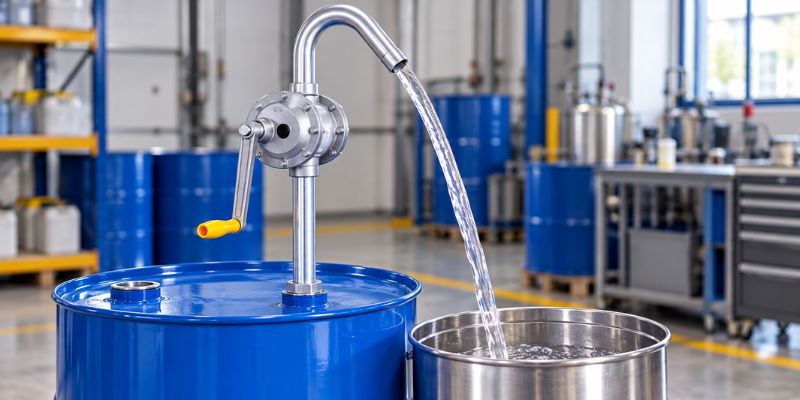
A barrel pump is a long, narrow, portable pump that goes in through the bung hole on top of a drum and pulls liquid straight up and out. You never have to tilt, roll, or tip a heavy drum to pour from it, which cuts spills and back injuries in one go.
Barrel pumps and drum pumps are the same thing. The name changes by region, but the job does not. Ambica’s hand-operated models use a 2-inch MNPT bung adapter and are listed for 5, 15, 30, and 55-gallon drums. The motor-operated models are made for 55-gallon (200-litre) drums. Every Ambica hand and motor barrel pump comes with a 1060 mm suction tube, long enough for a standard 200-litre drum. Always confirm fitment for your drum before ordering.
How Does a Barrel Pump Work?
Every barrel pump has three basic parts:
- Suction tube: Dips into the liquid and reaches close to the drum floor.
- Pumping unit: A rotary vane, a motor-driven impeller, or an air-driven mechanism that lifts the liquid up the tube.
- Outlet: A curved spout or a hose that sends the liquid into a container, tank, or machine.
The difference between the types of barrel pumps is only in what drives the pumping unit: your hand, an electric motor, or compressed air. That one choice decides flow rate, effort, and where the pump is safe to use.
What Are the Different Types of Barrel Pumps?
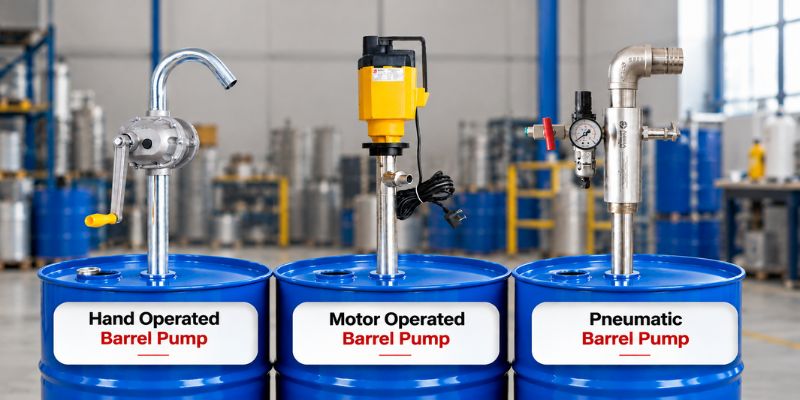
Hand-Operated Barrel Pump
A hand-operated barrel pump uses a rotary mechanism that you turn with a handle. Each turn pushes a fixed amount of liquid out of the spout. It needs no electricity and no compressed air, so it works anywhere, from a site godown to a farm shed.
Ambica makes three hand-operated models:
- AMTGBP-100 (aluminium with zinc-plated steel tube): About 1 litre per turn, with 15 metres vertical head and 50 metres horizontal. A 200-litre drum takes roughly 200 turns to empty, depending on how fast you crank. Built for low-viscosity fuels and oils such as diesel, petrol, kerosene, and machine oil. Weighs about 6 kg.
- AMTBPP-100 (polypropylene): 25 litres for every 130 turns, with a Viton seal and Ryton vane. This polypropylene barrel pump suits acids, alkalis, water, alcohol, and many other chemicals. Confirm seal compatibility for your chemical before ordering.
- AMTBSS-100 (stainless steel 304): 1 litre for every 3 to 4 turns, with SS304 wetted parts. Suits oils, water, alcohol, and mild chemicals where cleanliness matters.
Best for: small to medium daily volumes, sites with no power, and buyers who want a low-cost pump with almost nothing to maintain.
Motor-Operated Barrel Pump
A motor-operated barrel pump, often called an electric barrel pump, puts an electric motor on top of the tube to drive the pump. You switch it on, and it empties the drum at a steady rate with no operator fatigue. This is the type to choose when drum transfer is a daily, repeated job.
Ambica makes two motor-operated models, both with 100 litres per minute capacity, 10 metres vertical head, 40 mm inlet, 25 mm outlet, and a 1060 mm suction tube for 55-gallon drums:
- AMTMBP-100S: Stainless steel 304 and 316 construction for light oil, chemicals, and industrial acids.
- AMTMBP-100P: Polypropylene construction for light oil, chemicals, and industrial acids where a non-metal pump is preferred.
If you are already leaning toward this type, our guide to buying an electric barrel pump covers motor and power checks in more detail.
Best for: production lines, filling stations, and plants that empty several drums a day.
Pneumatic Barrel Pump
A pneumatic barrel pump runs on compressed air instead of electricity. With no electric motor at the drum, there is no electrical spark, so it is the usual choice for petrol, solvents, thinners, and other flammable liquids. In hazardous areas, ask your supplier for the zone rating and earth the pump, drum, and receiving container to prevent static discharge.
Ambica makes two air-operated models:
- AMTABP-50: Brass construction with an SS 316 suction pipe, up to 85 litres per minute, 10 metres max head, runs on 0.1 MPa air through an 8 mm air hose, about 5 kg.
- AMTMB-100: 60 litres per minute at rated head and up to 94 litres per minute at open discharge, 1000 mm immersion depth, open impeller, and a drive unit running at 17,000 to 21,000 RPM. Suited to clear liquids at ambient temperature that are compatible with SS 316, PP, or PVDF. It has a shutoff head of 17 m and a differential head of 8 m.
Best for: chemical plants, refineries, paint shops, fuel depots, and any area where an electric motor is a fire risk.
Hand vs Motor vs Pneumatic Barrel Pump
Here is how the three types of barrel pumps compare side by side.
| Aspect | Hand Operated | Motor Operated | Pneumatic |
| Power source | Manual handle | Electric motor | Compressed air |
| Flow rate | About 1 litre per turn (AMTGBP-100) | Up to 100 LPM | Up to 85 LPM (AMTABP-50) and up to 94 LPM (AMTMB-100) |
| Operator effort | High for big volumes | Low | Low |
| Safe near flammable fumes | Yes, if metal and earthed (small volumes) | Not unless rated for it | Yes, no electrical spark |
| Best for | Small volumes, no power on site | Daily, repeated transfer | Fuels, solvents, hazardous zones |
| Ambica models | AMTGBP-100, AMTBPP-100, AMTBSS-100 | AMTMBP-100S, AMTMBP-100P | AMTABP-50, AMTMB-100 |
Barrel Pump Materials and the Liquids They Suit
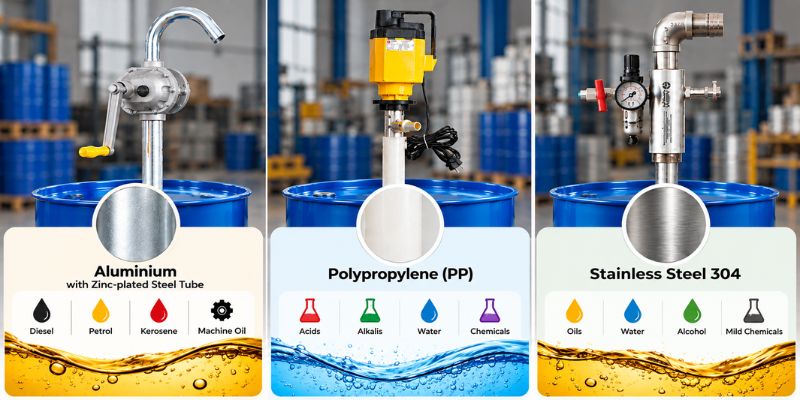
The drive type decides speed. The material decides how long the pump survives. A pump that is fast but made from the wrong material will corrode, swell, or leak within weeks.
| Material | Good For | Ambica Models |
| Aluminium with zinc-plated steel tube | Diesel, petrol, kerosene, machine oil, and other low-viscosity fluids | AMTGBP-100 |
| Polypropylene (PP) | Acids, alkalis, water, alcohol, many water-based chemicals | AMTBPP-100, AMTMBP-100P |
| Stainless steel 304 | Oils, water, alcohol, mild chemicals | AMTBSS-100, AMTMBP-100S |
| Stainless steel 316 | Solvents, fuels, and harsher chemicals | AMTMBP-100S, AMTMB-100, AMTABP-50 (SS 316 suction pipe) |
Always check the liquid against the wetted parts (tube, vane, seal) before you order. If you are not sure, send the chemical name and concentration to the supplier and ask them to confirm.
How to Pick the Right Barrel Pump
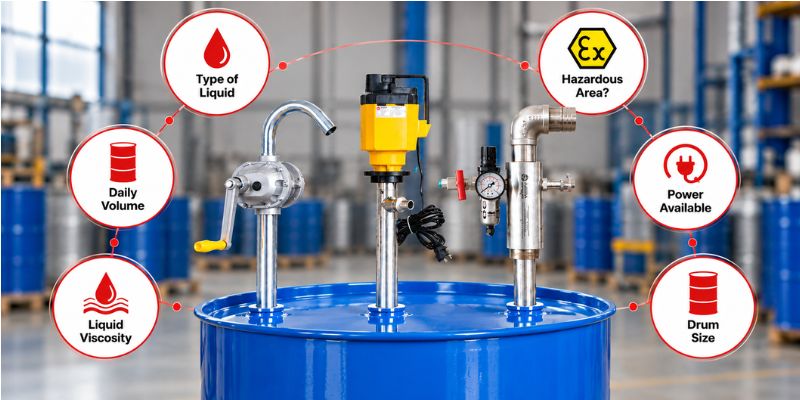
Work through these questions in order, and the choice usually makes itself.
- What liquid are you moving? Fuel and oil, acid, alkali, or solvent. This decides the material first.
- Is the area hazardous? If there are flammable fumes nearby, go pneumatic, or choose a metal hand-operated pump and earth it.
- How much do you move per day? One or two drums a week is fine with a hand pump. Several drums a day calls for a motor- or air-operated pump.
- What power is on site? No electricity means hand-operated. A plant air line makes pneumatic the easy choice.
- How thick is the liquid? Standard barrel pumps suit thin and medium liquids. For thick, abrasive, or slurry-type fluids, look at an AODD pump instead.
- What drum size do you use? Hand-operated models are listed for 5, 15, 30, and 55-gallon drums, and motor-operated models suit 55 gallon drums. Check the tube length against your drum height.
A good drum pump supplier will ask you these same questions before quoting. If they do not, that is a warning sign.
Common Mistakes When Buying a Barrel Pump
Buying on price alone: A cheap aluminium pump used for acid will fail fast and can contaminate the batch.
- Using an electric pump near solvents: A standard motor near flammable vapour is a real fire risk. Use a pneumatic pump instead.
- Ignoring daily volume: A hand pump for ten drums a day wears out the operator long before it wears out the pump.
- Skipping the seal check: The seal and vane fail before the tube. Confirm their material too, not just the body.
- Forgetting tube length: A tube that is too short leaves liquid at the bottom of every drum you buy.
If you want to compare barrel pumps with other pump families before you decide, our guide on types of pumps and their uses puts them side by side.
FAQs
What are the main types of barrel pumps?
The three main types of barrel pumps are hand-operated, motor-operated, and pneumatic (air-operated). Hand-operated pumps need no power and suit small daily volumes. Motor-operated pumps move up to 100 litres per minute for regular transfer. Pneumatic pumps run on compressed air, so there is no electric motor at the drum, which is why they are the usual choice for flammable liquids.
Which barrel pump is best for diesel and oil?
For diesel, kerosene, and machine oil, a rotary hand-operated barrel pump in aluminium with a zinc-plated steel tube works well and gives about 1 litre per turn. If you empty several drums of diesel or oil a day, a motor-operated barrel pump in stainless steel saves time and effort. For petrol, or any fuel transfer in a hazardous zone, a pneumatic barrel pump is the safer choice.
Which barrel pump is safe for flammable liquids?
A pneumatic barrel pump is the usual choice for flammable liquids such as petrol, thinners, and solvents. It runs on compressed air instead of an electric motor, so there is no electrical spark at the drum. In hazardous areas, confirm the zone rating with your supplier and earth the pump, drum, and receiving container to prevent static discharge. A metal hand-operated pump, also earthed, is another option for small volumes.
Is a barrel pump the same as a drum pump?
Yes. Barrel pump and drum pump are two names for the same equipment. Both are long, portable pumps that fit through the 2-inch bung opening of a standard 200 litre (55 gallon) drum to take liquid out without tilting the drum.
Can a barrel pump handle thick liquids?
Standard barrel pumps are built for thin and medium liquids such as oils, diesel, chemicals, acids, and solvents. Flow drops sharply as the liquid gets thicker, so grease or heavy resin is not a good fit for a standard model. For thick or abrasive fluids, an AODD pump is usually the better choice.
Conclusion
The right barrel pump comes down to three things: the liquid, the volume, and the site. A hand-operated pump is the simple, low-cost choice for small volumes and places with no power. A motor-operated pump saves time and effort when you empty drums every day. A pneumatic pump is the usual choice for fuels, solvents, and hazardous areas. Start with the liquid, which sets the material, then pick the drive type that fits your site, volume, and safety needs. Get both right, and the pump will serve you well for years.
For help choosing the right model, talk to an experienced barrel pump manufacturer. Ambica Machine Tools is an ISO 9001:2015 certified company, and its barrel pumps carry a CE certificate. Contact us at info@ambicamachinetools.com or +91 96012 53837.