
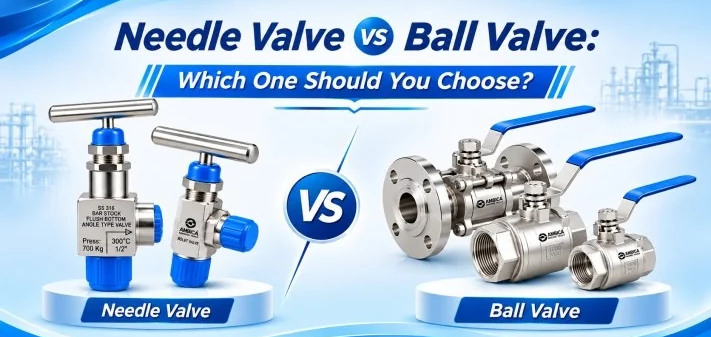
Needle Valve vs Ball Valve: Which One Should You Choose?
By Ambica Machine Tools Technical Team
Table of Content:
- What Is a Needle Valve?
- What Is a Ball Valve?
- Needle Valve vs Ball Valve: Key Differences
- When to Use a Needle Valve
- When to Use a Ball Valve
- Pressure Ratings, Materials and Seals
- How to Choose Between a Needle Valve and a Ball Valve
- Common Mistakes When Buying Valves
- FAQs
- Conclusion
Quick Takeaways
- A needle valve gives fine, controlled flow adjustment. A ball valve gives fast, full on/off shut-off.
- A needle valve opens slowly over many turns of a threaded stem. A ball valve opens or closes with a quarter turn.
- A fully open ball valve causes very little pressure drop. A needle valve always restricts flow more for the same size.
- Use needle valves for instrumentation lines, gauge isolation, sampling, bleeding and test benches. Use ball valves for line isolation and quick shut-off.
- Avoid using a standard ball valve to throttle flow for long periods, because the seats can wear out.
- Pick the valve by its job first, then by pressure, liquid or gas, material, end connection and size.
People often ask whether they should buy a needle valve or a ball valve for a high pressure line. Both can be built for high pressure, so pressure alone does not decide the answer. The real question is what you want the valve to do: control the flow gently, or open and close it fast.
Picking the wrong one causes real problems. A ball valve used to throttle wears its seats and starts to leak. A needle valve used for frequent shut-off wastes time and wears the stem. This guide explains how each valve works, where each one fits, and how to choose with confidence.
What Is a Needle Valve?
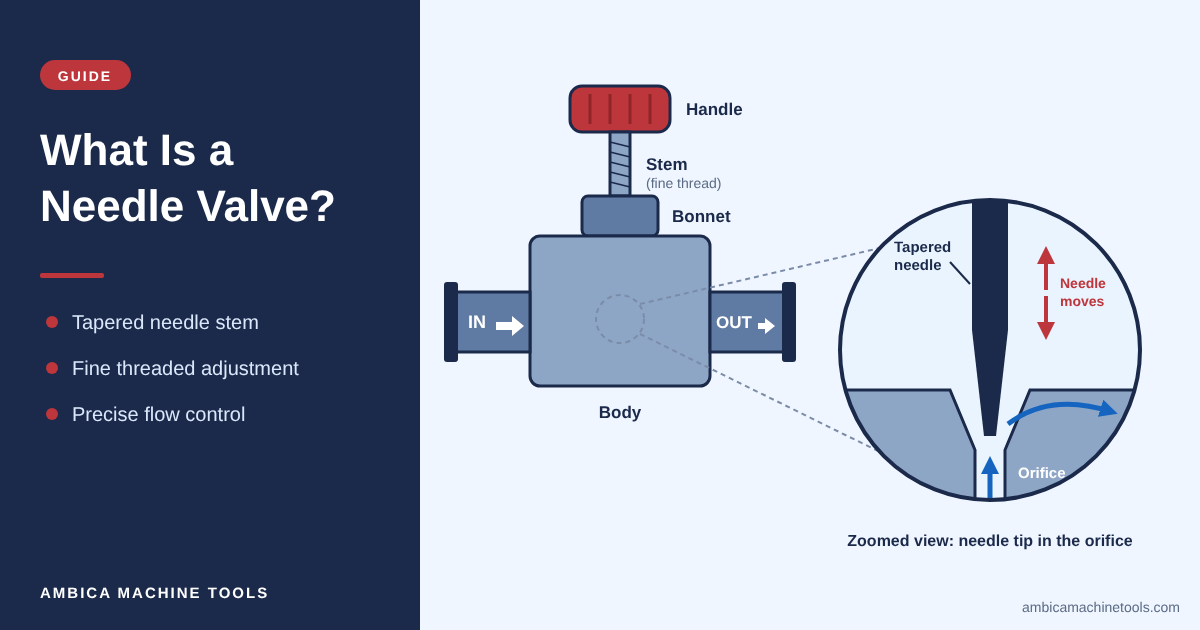
A needle valve has a long, tapered, needle-shaped stem that sits in a small opening called the orifice. You turn the handle, and the stem moves slowly in or out. Because the thread is fine, each turn changes the opening by only a tiny amount. This is what gives a needle valve its precise control.
A needle valve usually needs several full turns to go from closed to fully open. That makes it slow to operate, but it lets you set a flow rate very exactly. Needle valves are common on small-bore lines where accuracy matters more than speed.
Typical uses: pressure gauge and transmitter lines, sampling points, bleed and vent points, instrument panels, hydraulic and test setups.
What Is a Ball Valve?
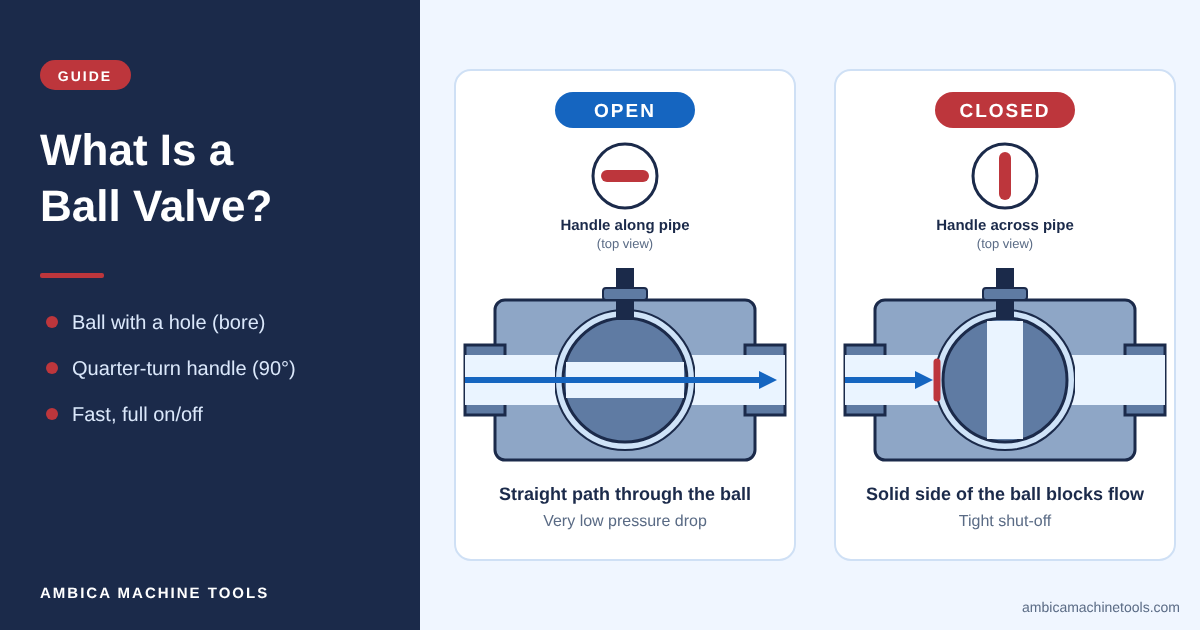
A ball valve has a round ball with a hole through the middle, called the bore. When the bore lines up with the pipe, liquid flows straight through. A quarter turn (90 degrees) of the handle rotates the ball so the solid side blocks the flow.
Because the ball is either fully open or fully closed, a ball valve is quick and simple to operate. The handle position also shows at a glance whether the valve is open or closed. A full-bore ball valve lets liquid pass with very little pressure loss.
Typical uses: line isolation, quick shut-off, process piping, fuel and chemical lines, and any place where the valve is opened and closed often.
Needle Valve vs Ball Valve: Key Differences
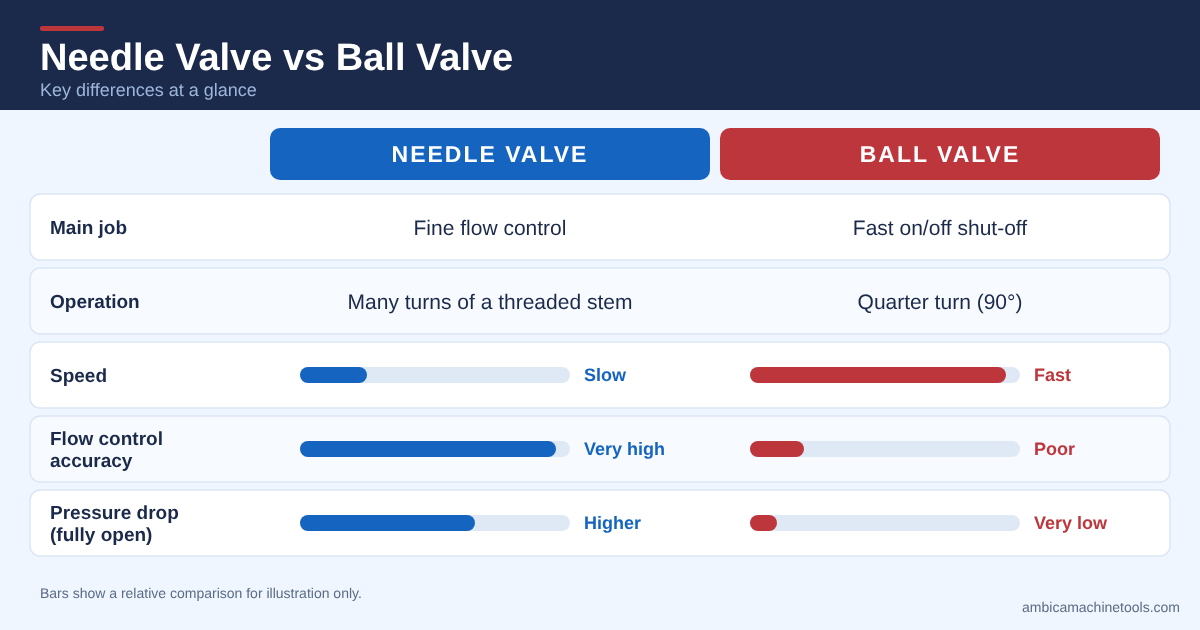
Here is how the two valves compare side by side.
| Aspect | Needle Valve | Ball Valve |
|---|---|---|
| Main job | Fine flow control (throttling) | Fast on/off shut-off |
| Operation | Many turns of a threaded stem | Quarter turn (90 degrees) |
| Speed of operation | Slow | Fast |
| Flow control accuracy | Very high | Poor (open or closed) |
| Pressure drop when fully open | Higher, flow is restricted | Very low in full-bore types |
| Typical line size | Small bore | Small to large bore |
| Wear when throttling | Designed for it | Seats can wear if used part-open |
| Water hammer risk | Low, closes slowly | Higher in liquid lines if closed too fast |
| Open/closed indication | Not obvious from the handle | Clear from the handle position |
| Best for | Instruments, gauges, sampling, test benches | Isolation and quick shut-off |
When to Use a Needle Valve
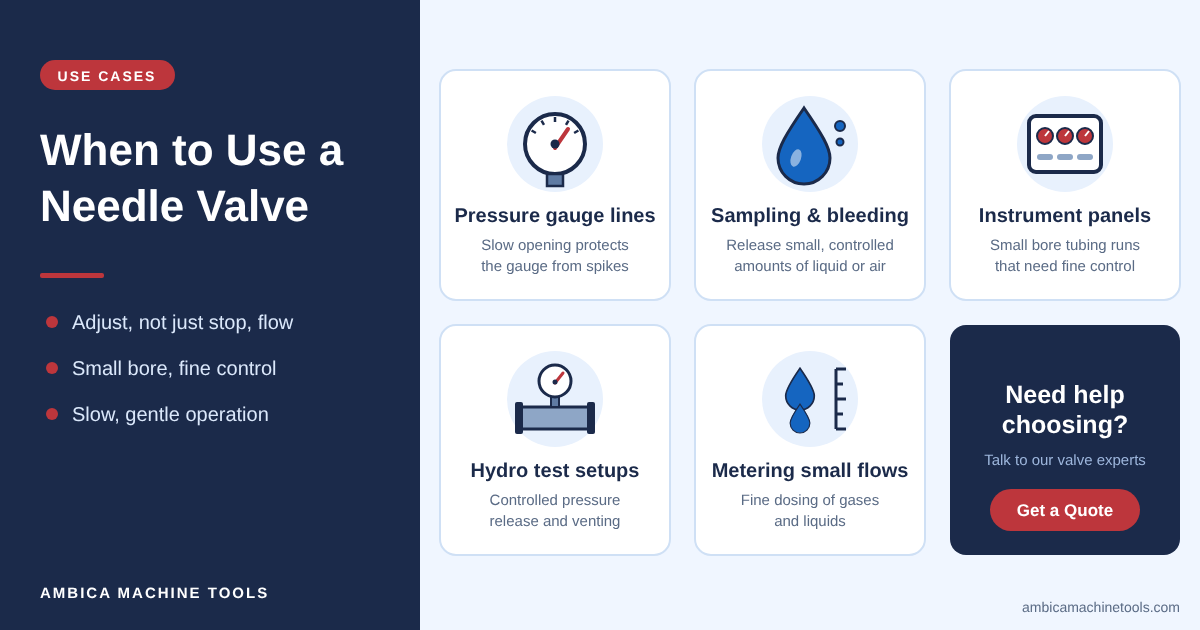
Choose a needle valve when you need to adjust, not just stop, the flow.
- Pressure gauge lines: A slow-opening valve protects the gauge from a sudden pressure spike. Gauge root valves and gauge isolation valves are built on this idea.
- Sampling and bleeding: You can release a small, controlled amount of liquid or air without a sudden rush.
- Instrumentation and control panels: Small bore and fine control suit tubing runs that feed instruments.
- Hydro test and pressure test setups: Needle valves are used for controlled pressure release and venting.
- Metering small flows: Dosing or fine adjustment of gases and liquids in test and lab setups.
If you need a valve for these jobs, see our high pressure needle valves, multi port gauge valves and gauge root valves.
When to Use a Ball Valve
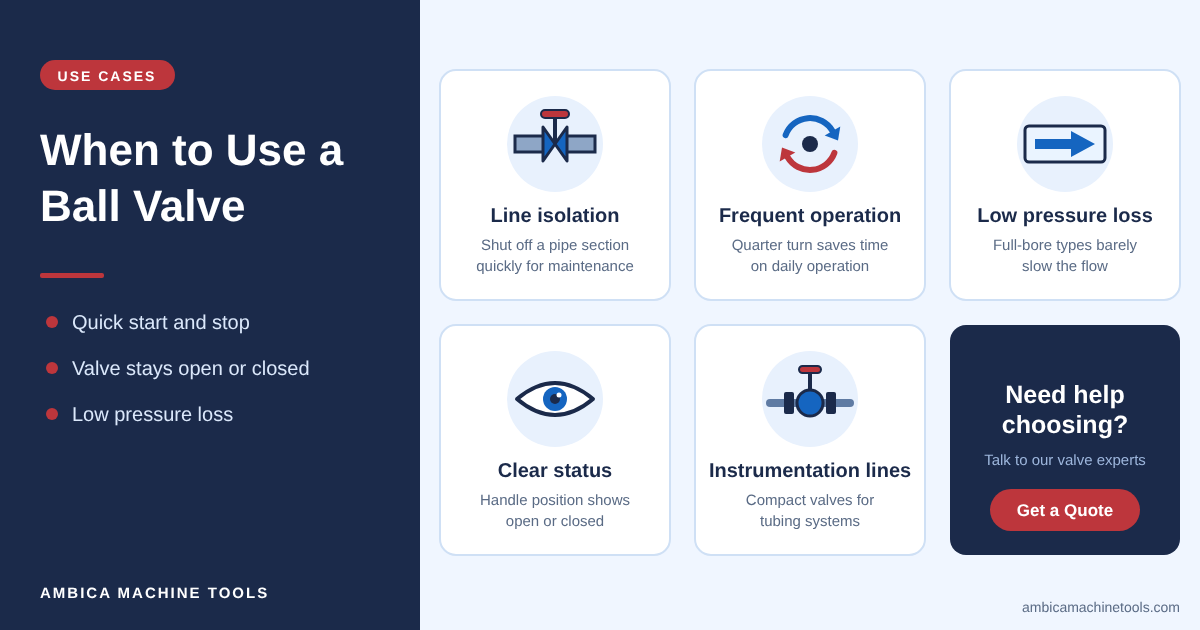
Choose a ball valve when you need to start or stop the flow quickly and the valve will sit fully open or fully closed most of the time.
- Line isolation: Shut off a section of pipe for maintenance in seconds.
- Frequent operation: The quarter-turn handle saves time when valves are used many times a day.
- Low pressure loss: A full-bore ball valve barely slows the flow, which keeps pump energy use down.
- Clear status: You can see from the handle whether the valve is open or closed.
- Instrumentation lines needing quick isolation: Compact instrumentation ball valves suit tubing systems.
For these jobs, look at our high pressure ball valves and instrumentation ball valves.
Pressure Ratings, Materials and Seals
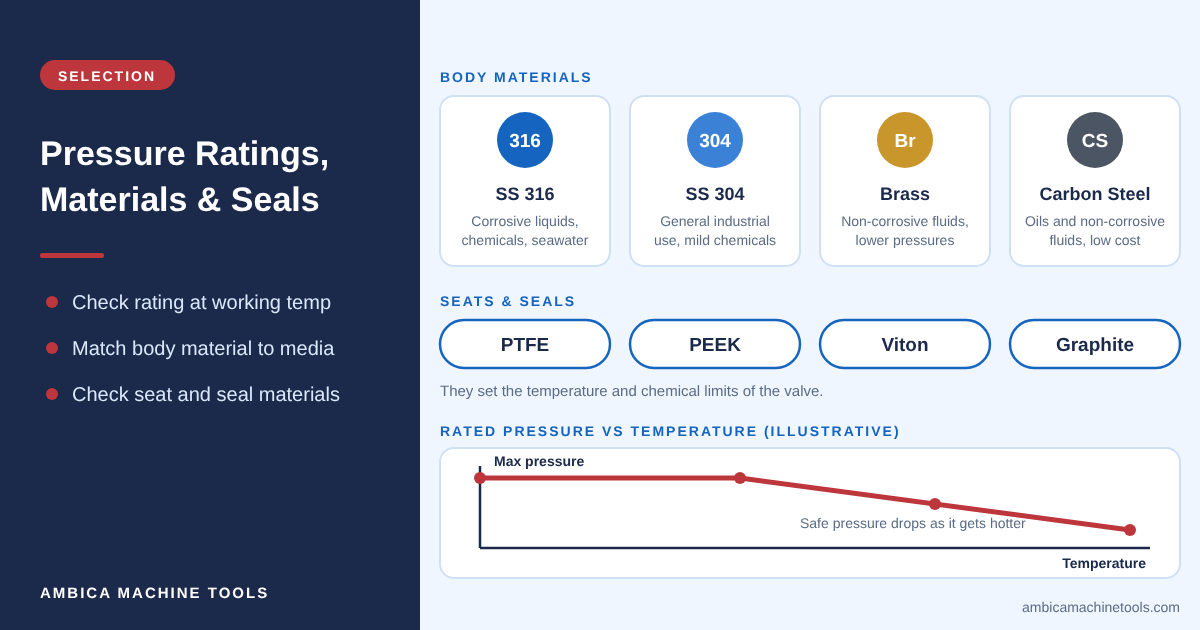
Both valves can be made for high pressure, but the rating depends on the body material, size, seat and seals. Always check the rated pressure at your working temperature, because the safe pressure usually drops as temperature rises.
Common body materials
- Stainless steel 316: Good for corrosive liquids, chemicals and seawater environments.
- Stainless steel 304: Suits general industrial use and mild chemicals.
- Brass: Suits non-corrosive liquids and gases at lower pressures.
- Carbon steel: Suits oils and non-corrosive fluids where cost matters.
Seats and seals (such as PTFE, PEEK, Viton or graphite packing) set the temperature and chemical limits of the valve. A strong body with the wrong seal will still leak.
Ambica range
- Ambica high pressure needle valves: [CONFIRM: up to 14,500 PSI (1,000 bar), sizes from 1/4 inch to 5 inch. Check this against your product page and datasheet.]
- Ambica high pressure ball valves: [ADD: pressure rating, size range, body material, seat material, end connections.]
- [ADD: certifications or test reports you can supply, for example material test certificates.]
How to Choose Between a Needle Valve and a Ball Valve
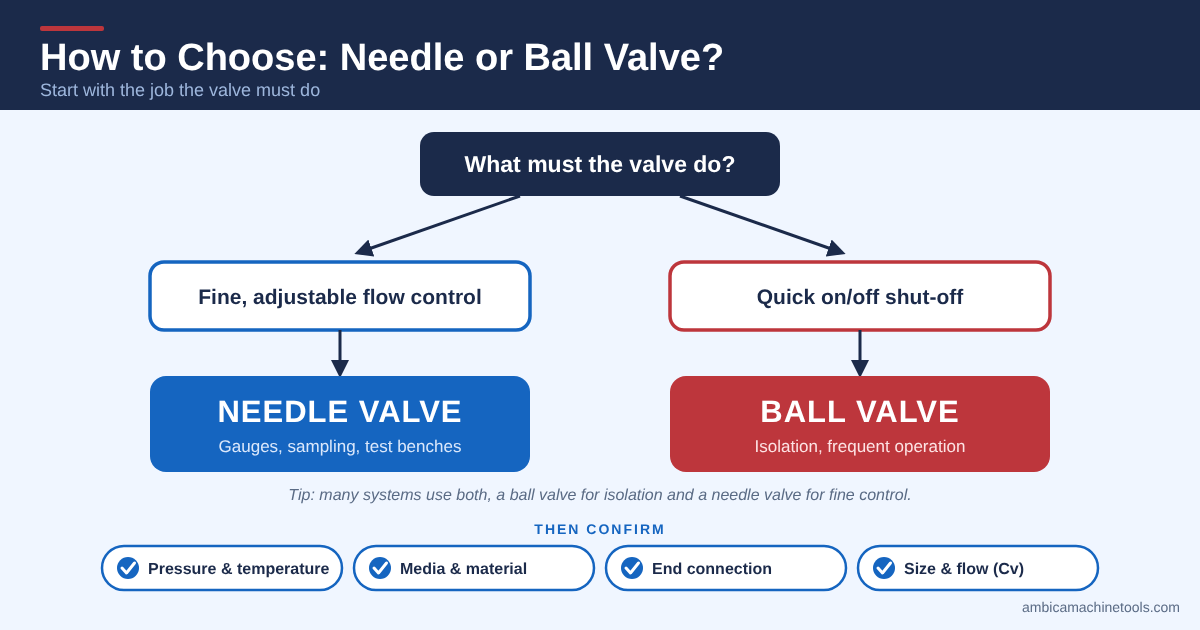
Work through these questions in order.
- What must the valve do? Fine flow control means a needle valve. Fast shut-off means a ball valve.
- How often will it be operated? Several times a day points to a ball valve. Occasional fine adjustment points to a needle valve.
- What is the working pressure and temperature? Pick a valve rated above your maximum, with margin, at your working temperature.
- What is flowing through it? Liquid, gas, acid, oil or steam decides the body, seat and seal materials.
- How much flow do you need? Needle valves pass less flow for the same size. If flow rate matters, check the flow coefficient (Cv) or ask the supplier.
- What are your connections? Match the end type to your line: NPT, BSP, tube fitting or welded ends.
- Do you need both? Many systems use a ball valve for isolation and a needle valve right after it for fine control.
Common Mistakes When Buying Valves
- Throttling with a standard ball valve: Leaving it half open wears the seats and causes leaks. If you need control, use a needle valve or a ball valve made for flow control.
- Using a needle valve for frequent shut-off: It is slow and the stem wears faster from repeated use.
- Ignoring temperature: A valve rated for high pressure at room temperature may not hold that pressure when hot.
- Skipping the seal check: The body may suit the liquid while the seat or packing does not.
- Closing a ball valve too fast on a liquid line: A sudden stop can cause a pressure surge known as water hammer.
- Choosing on price alone: A cheap valve in the wrong material fails early and costs more in downtime.
FAQs
What is the main difference between a needle valve and a ball valve?
A needle valve is made for precise flow control using a tapered stem and a fine thread. A ball valve is made for fast on/off shut-off using a quarter-turn ball. In short, use a needle valve to adjust flow and a ball valve to start or stop it.
Can a needle valve be used as a shut-off valve?
Yes, a closed needle valve can shut off flow. But it is slow to operate, so it is not the best choice where the valve is opened and closed often. For frequent shut-off, a ball valve is better.
Can a ball valve be used to control flow?
A standard ball valve is not meant for flow control, because leaving it part open can wear the seats. Special V-port ball valves are designed for flow control. For fine control on small lines, a needle valve is the usual choice.
Which valve is better for high pressure?
Neither is better in every case. Both can be made for high pressure. Choose by the job: needle valve for control, ball valve for shut-off. Then check the rated pressure, temperature and material for your application.
Why is a needle valve used on pressure gauge lines?
It opens slowly and in small steps, so pressure builds up gradually instead of hitting the gauge all at once. This protects the gauge and also lets you isolate it for removal.
Conclusion
The choice between a needle valve and a ball valve comes down to the job. Pick a needle valve when you need fine, steady control of a small flow, such as on gauge lines, sampling points and test benches. Pick a ball valve when you need quick, tight shut-off with low pressure loss. Then confirm the pressure, temperature and materials fit your application.
For help choosing the right valve, talk to an experienced high pressure valve manufacturer. Ambica Machine Tools is an ISO 9001:2015 certified company. You can also download our product brochures from the catalog page. Contact us at info@ambicamachinetools.com or +91 96012 53837.